
4 important legal pages your blog needs
Once your blog is up and running there are a few essential legal pages your website needs.
These policies aren’t just for someone who wants to make a living from blogging, as they cover some privacy issues that are relevant to your blog even if your readers don’t spend anything on your site.
The good news is that while it may take an hour or two to get your legal pages on your website, once those legal pages are ready you don’t need to think about them anymore!
It’s a rare thing in blogging to find an area you can do just once and then move on from! Everything else, from writing actual blog posts to promoting them, is an ongoing task.
As well as legal pages, you will also need to do a few simple things to make sure your blog is GDPR-compliant. This issue is related to the collection of people’s personal data via things like your mailing list sign-up and comments function on your blog posts, which collect people’s names and email addresses.
You may also like:
How to start a money-making blog
Why your blog needs legal pages
So why do you need legal pages on your blog? Why should you bother with them when you’re starting out and your traffic is low?
Look, chances are if you do not add these pages to your blog right away, you will be absolutely fine.
But somewhere down the line you may start collecting email addresses for your mailing list. You may add the odd affiliate link. You might want to sell products.
It’s far better to have these things set up right now, from day one, so that you are complying with legal re quirements and you’re being totally up front with your audience.
This post will tell you the four legal pages your blog needs, and then how to write them or add them to your blog (for free).
For some of these pages, there are plugins you can get for free that make your site compliant. Others just need a little bit of cutting and pasting of some legal jargon, with a little editing to make it relevant for your site, then you’re good to go.
While the terminology in this blog post might seem a little daunting, trust me when I say this is not a huge time drain. You can get these done and dusted within a couple of hours.
The legal pages your blog needs
Privacy policy
Your privacy policy tells your blog visitors all the ways you will collect their data and explains what you do with it.
At the very least your blog probably has a comments feature which will require users to type in their email address. This is just one tiny example of how your blog is collecting personal data.
If you’re using Google Analytics, which you absolutely should be in order to track your blog stats, your blog will also use things like cookies to store information on your website visitors such as location.
As your blog grows and you start a mailing list, this is another example of your blog collecting and storing people’s data.
So your blog needs a privacy policy page setting out all the ways you hold their data, as well as informing them they have the right to opt out of things like your mailing list if they choose.
Having a privacy policy is part of what you need to be GDPR compliant. What’s GDPR? There’s a great explanation of what it is and how it impacts bloggers over here.
But to give you an idea, it’s an EU law that toughens up rules around data protection and how companies, websites and organisations store and process data.
Having a privacy policy is one of the key ways you can ensure you are GDPR compliant.
There’s a great privacy policy generator here, and it’s free.

Disclosure
Planning to work with brands and make money with affiliate links? You need a disclosure page!
Your disclosure page explains to your audience what your relationship with brands and other organisations is when you are making money from those relationships.
If a brand pays you to write a post about their product, or link back to their website from a post on a particular topic you are writing, you need to disclose the deal between you and the brand.
You will need to disclose this within the post itself, but it’s also a good idea to disclose that you have sponsored posts on your site.
As part of this disclosure page you also need to disclose your use of affiliate links.
Again, one disclosure page to cover your whole site isn’t quite enough, you will need to disclose your use of affiliate links in individual posts where you use them.
Affiliate marketing disclosure in posts
You need to disclose your use of affiliate links before the link itself in posts. To make it quicker to add a line in your posts disclosing your affiliate links, you can make a reusable “block” in WordPress which you simply slot in before hitting publish.
I tend to pop my affiliate disclosure block in about five pars into the post. As long as it comes before any affiliate links, you’re fine!
To make a reusable block, simply:
- Write out your disclosure wording. I suggest something along these lines: This post contains affiliate links. This means I will receive a commission for any purchases made via the links but it does not cost you any more.
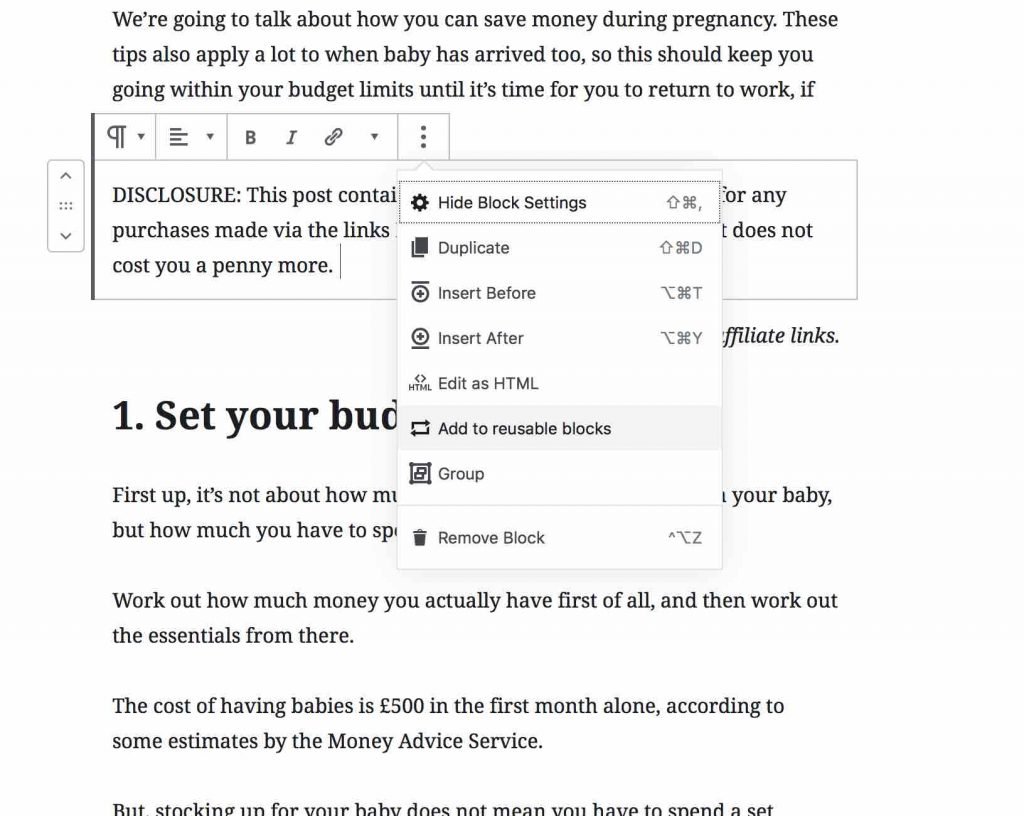
- Now, click the three small dots that appear when the block is highlighted and select the reusable blocks option.
- Give the block and name and it will be added to your reusable blocks for next time so you can streamline the process.

Disclaimer
Your disclaimer page explains to your audience that you cannot accept liability for the way they use the information on your blog.
It’s really important for areas such as health, finances and legal advice, but it’s worth having a disclaimer page on any type of blog.
There are some great sample disclaimer pages on this site.
Terms and conditions
You are not legally required to have a terms and conditions page but it helps to set out the terms of use for your website and it can protect you from legal liability. They’re also referred to as the Terms of Use or Terms of Service.
You can find some great free templates online, but here are a few basics of what your terms and conditions may include:
- A statement removing your liability for any errors in your content and stating you can’t be held responsible for these.
- A copyright notice
- Explanation of what is permitted on your site, for example no abusive language or harassment.
- Intellectual property rights explaining your blog content should not be copied or misused.
- Refund or exchange policy if you sell products or services on your site.
Final thoughts on legal pages for your blog
This post sets out the legal pages your blog will need. It hopefully will give you an idea of where to start when it comes to writing your own.
There are many templates out there on the internet, so I suggest that you don’t need to worry about paying someone to write these legal pages for you.
When producing your own legal pages, go over the details that are applicable to your own site such as how you collect personal data (email addresses from subscribers, Google Analytics, emails from comments etc) and what type of information you are providing.
Try not to be daunted, once you break it down one page at a time, you’ll get there in no time.


